what are the strongest types of intermolecular forces that must be overcome in order to:
Chapter 10. Liquids and Solids
10.1 Intermolecular Forces
Learning Objectives
Past the end of this section, you will exist able to:
- Describe the types of intermolecular forces possible between atoms or molecules in condensed phases (dispersion forces, dipole-dipole attractions, and hydrogen bonding)
- Identify the types of intermolecular forces experienced by specific molecules based on their structures
- Explain the relation between the intermolecular forces present within a substance and the temperatures associated with changes in its physical state
As was the instance for gaseous substances, the kinetic molecular theory may be used to explain the behavior of solids and liquids. In the post-obit description, the term particle will be used to refer to an atom, molecule, or ion. Notation that we will use the popular phrase "intermolecular attraction" to refer to attractive forces between the particles of a substance, regardless of whether these particles are molecules, atoms, or ions.
Consider these two aspects of the molecular-level environments in solid, liquid, and gaseous matter:
- Particles in a solid are tightly packed together and often arranged in a regular blueprint; in a liquid, they are close together with no regular system; in a gas, they are far apart with no regular arrangement.
- Particles in a solid vibrate about fixed positions and do not generally move in relation to 1 another; in a liquid, they movement past each other just remain in substantially constant contact; in a gas, they motion independently of one some other except when they collide.
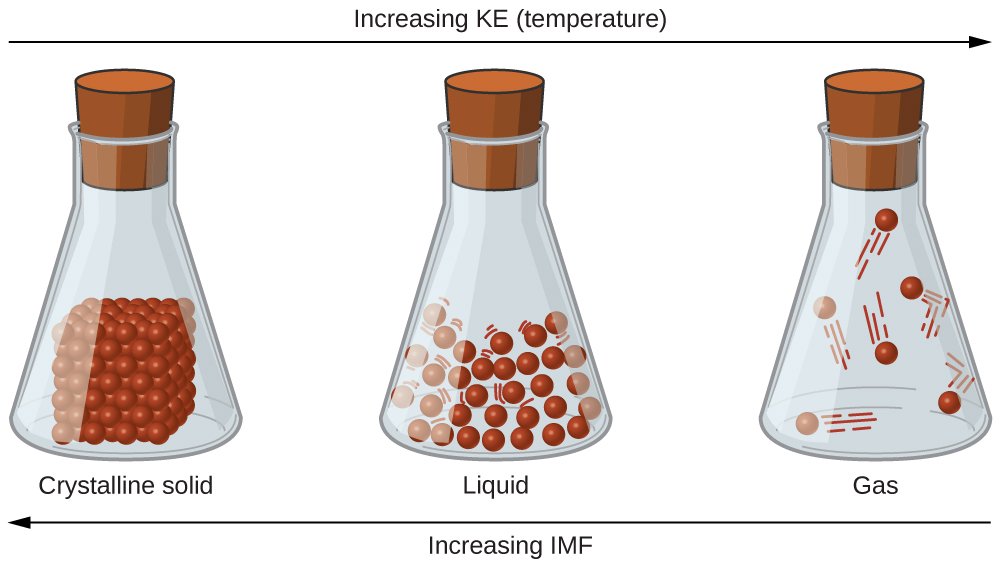
The differences in the properties of a solid, liquid, or gas reflect the strengths of the bonny forces between the atoms, molecules, or ions that make up each phase. The stage in which a substance exists depends on the relative extents of its intermolecular forces (IMFs) and the kinetic energies (KE) of its molecules. IMFs are the diverse forces of attraction that may exist between the atoms and molecules of a substance due to electrostatic phenomena, as will be detailed in this module. These forces serve to agree particles close together, whereas the particles' KE provides the energy required to overcome the attractive forces and thus increase the distance between particles. Figure 1 illustrates how changes in physical land may be induced by irresolute the temperature, hence, the average KE, of a given substance.
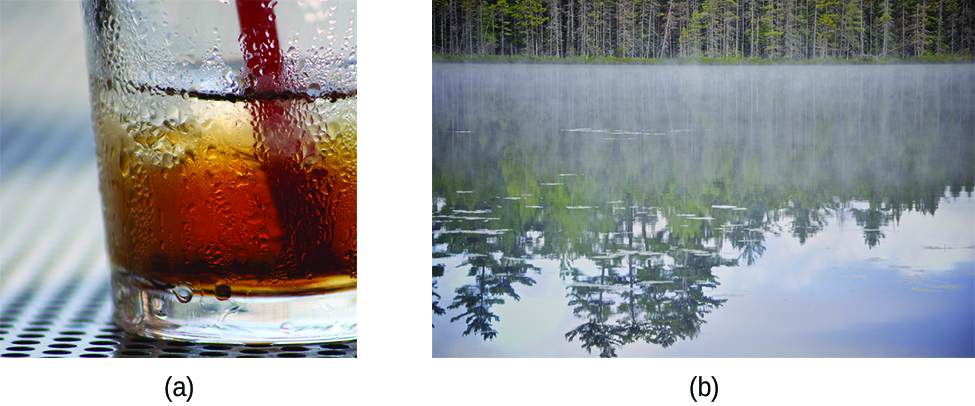
As an example of the processes depicted in this figure, consider a sample of water. When gaseous water is cooled sufficiently, the attractions between HtwoO molecules will exist capable of holding them together when they come into contact with each other; the gas condenses, forming liquid HiiO. For example, liquid water forms on the outside of a common cold drinking glass equally the water vapor in the air is cooled by the cold glass, equally seen in Figure two.
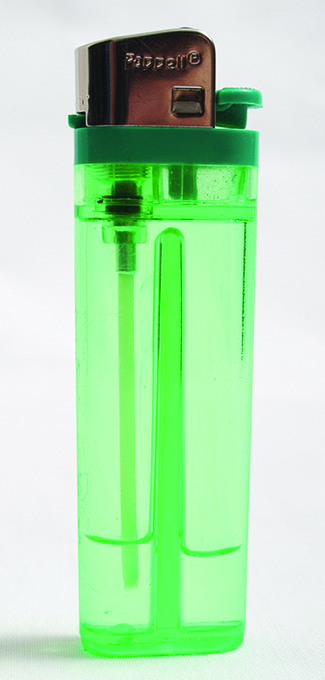
We can also liquefy many gases by compressing them, if the temperature is not too loftier. The increased pressure brings the molecules of a gas closer together, such that the attractions between the molecules become strong relative to their KE. Consequently, they class liquids. Butane, C4H10, is the fuel used in disposable lighters and is a gas at standard temperature and pressure. Within the lighter'south fuel compartment, the butane is compressed to a pressure that results in its condensation to the liquid land, as shown in Figure three.
Finally, if the temperature of a liquid becomes sufficiently low, or the pressure on the liquid becomes sufficiently high, the molecules of the liquid no longer have enough KE to overcome the IMF between them, and a solid forms. A more thorough discussion of these and other changes of state, or stage transitions, is provided in a after module of this chapter.

Access this interactive simulation on states of matter, phase transitions, and intermolecular forces. This simulation is useful for visualizing concepts introduced throughout this chapter.
Forces between Molecules
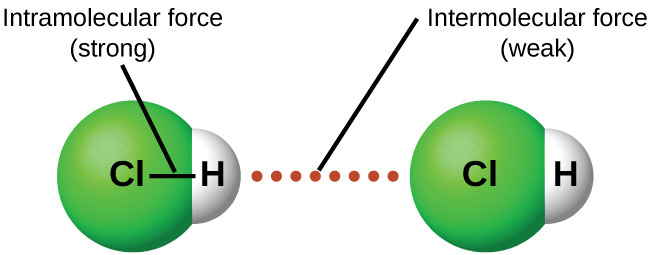
Under appropriate conditions, the attractions between all gas molecules will cause them to form liquids or solids. This is due to intermolecular forces, not intramolecular forces. Intramolecular forces are those within the molecule that proceed the molecule together, for example, the bonds between the atoms. Intermolecular forces are the attractions between molecules, which determine many of the physical backdrop of a substance. Figure four illustrates these dissimilar molecular forces. The strengths of these bonny forces vary widely, though usually the IMFs betwixt small molecules are weak compared to the intramolecular forces that bond atoms together within a molecule. For case, to overcome the IMFs in i mole of liquid HCl and catechumen it into gaseous HCl requires just about 17 kilojoules. Nonetheless, to break the covalent bonds betwixt the hydrogen and chlorine atoms in one mole of HCl requires about 25 times more than energy—430 kilojoules.
All of the attractive forces between neutral atoms and molecules are known every bit van der Waals forces, although they are ordinarily referred to more informally equally intermolecular allure. We will consider the diverse types of IMFs in the next 3 sections of this module.
Dispersion Forces
One of the iii van der Waals forces is present in all condensed phases, regardless of the nature of the atoms or molecules composing the substance. This attractive force is called the London dispersion force in honor of German-built-in American physicist Fritz London who, in 1928, first explained it. This force is oftentimes referred to as simply the dispersion force. Because the electrons of an atom or molecule are in constant motion (or, alternatively, the electron's location is subject to breakthrough-mechanical variability), at any moment in fourth dimension, an atom or molecule tin can develop a temporary, instantaneous dipole if its electrons are distributed asymmetrically. The presence of this dipole can, in plough, distort the electrons of a neighboring atom or molecule, producing an induced dipole. These 2 chop-chop fluctuating, temporary dipoles thus outcome in a relatively weak electrostatic attraction between the species—a so-called dispersion forcefulness like that illustrated in Figure 5.
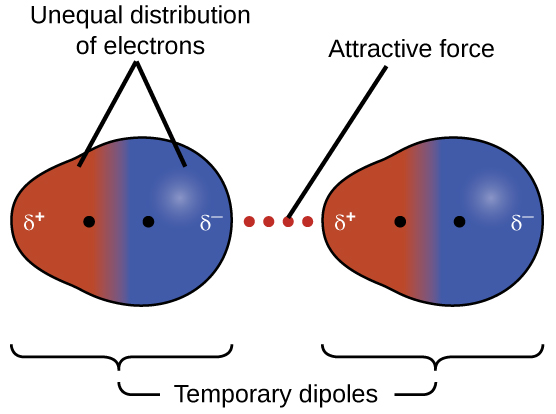
Dispersion forces that develop between atoms in different molecules can concenter the two molecules to each other. The forces are relatively weak, yet, and become meaning only when the molecules are very close. Larger and heavier atoms and molecules exhibit stronger dispersion forces than do smaller and lighter atoms and molecules. Ftwo and Cl2 are gases at room temperature (reflecting weaker attractive forces); Br2 is a liquid, and I2 is a solid (reflecting stronger attractive forces). Trends in observed melting and humid points for the halogens clearly demonstrate this effect, as seen in Tabular array ane.
| Halogen | Molar Mass | Atomic Radius | Melting Point | Humid Bespeak |
|---|---|---|---|---|
| fluorine, Ftwo | 38 thousand/mol | 72 pm | 53 K | 85 K |
| chlorine, Cl2 | 71 1000/mol | 99 pm | 172 M | 238 K |
| bromine, Br2 | 160 thousand/mol | 114 pm | 266 K | 332 K |
| iodine, I2 | 254 g/mol | 133 pm | 387 K | 457 K |
| astatine, At2 | 420 g/mol | 150 pm | 575 Thousand | 610 Chiliad |
| Table 1. Melting and Boiling Points of the Halogens | ||||
The increase in melting and boiling points with increasing atomic/molecular size may exist rationalized by considering how the force of dispersion forces is afflicted by the electronic construction of the atoms or molecules in the substance. In a larger atom, the valence electrons are, on average, farther from the nuclei than in a smaller atom. Thus, they are less tightly held and can more easily form the temporary dipoles that produce the allure. The measure of how easy or difficult it is for another electrostatic charge (for example, a nearby ion or polar molecule) to distort a molecule'south charge distribution (its electron cloud) is known as polarizability. A molecule that has a charge cloud that is hands distorted is said to be very polarizable and will accept big dispersion forces; one with a charge cloud that is difficult to distort is not very polarizable and will have small dispersion forces.
Instance 1
London Forces and Their Furnishings
Society the following compounds of a group 14 element and hydrogen from lowest to highest humid point: CHfour, SiHfour, GeH4, and SnH4. Explain your reasoning.
Solution
Applying the skills caused in the chapter on chemic bonding and molecular geometry, all of these compounds are predicted to be nonpolar, and so they may experience just dispersion forces: the smaller the molecule, the less polarizable and the weaker the dispersion forces; the larger the molecule, the larger the dispersion forces. The molar masses of CHiv, SiH4, GeHfour, and SnHiv are approximately xvi m/mol, 32 g/mol, 77 thousand/mol, and 123 g/mol, respectively. Therefore, CH4 is expected to have the everyman humid indicate and SnH4 the highest humid bespeak. The ordering from lowest to highest boiling betoken is expected to exist CH4 < SiHiv < GeH4 < SnHiv.

A graph of the actual boiling points of these compounds versus the period of the group 14 element shows this prediction to be correct:
Check Your Learning
Order the post-obit hydrocarbons from lowest to highest boiling point: CiiH6, CthreeH8, and C4H10.
Answer:
C2H6 < C3H8 < C4H10. All of these compounds are nonpolar and merely take London dispersion forces: the larger the molecule, the larger the dispersion forces and the college the boiling betoken. The ordering from lowest to highest humid point is therefore C2H6 < C3Height < C4Hten.
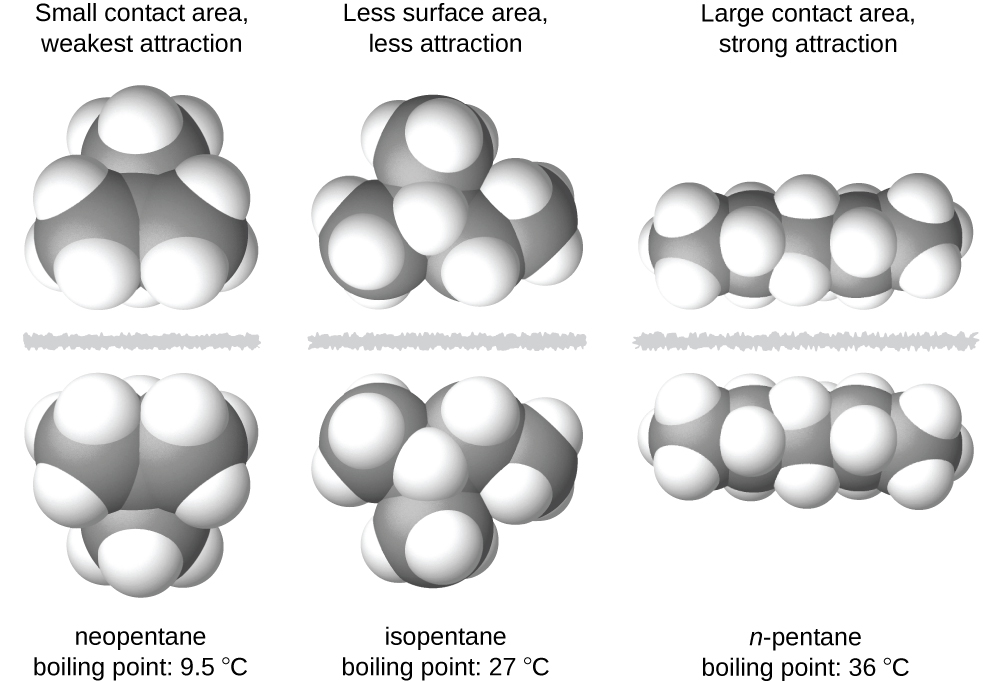
The shapes of molecules also affect the magnitudes of the dispersion forces betwixt them. For example, boiling points for the isomers northward-pentane, isopentane, and neopentane (shown in Figure vi) are 36 °C, 27 °C, and 9.5 °C, respectively. Even though these compounds are composed of molecules with the same chemical formula, CvH12, the difference in boiling points suggests that dispersion forces in the liquid phase are different, being greatest for due north-pentane and least for neopentane. The elongated shape of n-pentane provides a greater surface area bachelor for contact betwixt molecules, resulting in correspondingly stronger dispersion forces. The more than compact shape of isopentane offers a smaller surface area available for intermolecular contact and, therefore, weaker dispersion forces. Neopentane molecules are the near compact of the three, offer the least bachelor surface surface area for intermolecular contact and, hence, the weakest dispersion forces. This beliefs is analogous to the connections that may be formed between strips of VELCRO brand fasteners: the greater the area of the strip's contact, the stronger the connection.
Geckos and Intermolecular Forces
Geckos have an amazing ability to attach to nearly surfaces. They tin can apace stitch shine walls and beyond ceilings that have no toe-holds, and they do this without having suction cups or a sticky substance on their toes. And while a gecko can lift its feet hands as it walks along a surface, if you endeavor to pick it upwardly, it sticks to the surface. How are geckos (likewise every bit spiders and some other insects) able to practice this? Although this phenomenon has been investigated for hundreds of years, scientists just recently uncovered the details of the procedure that allows geckos' feet to conduct this way.
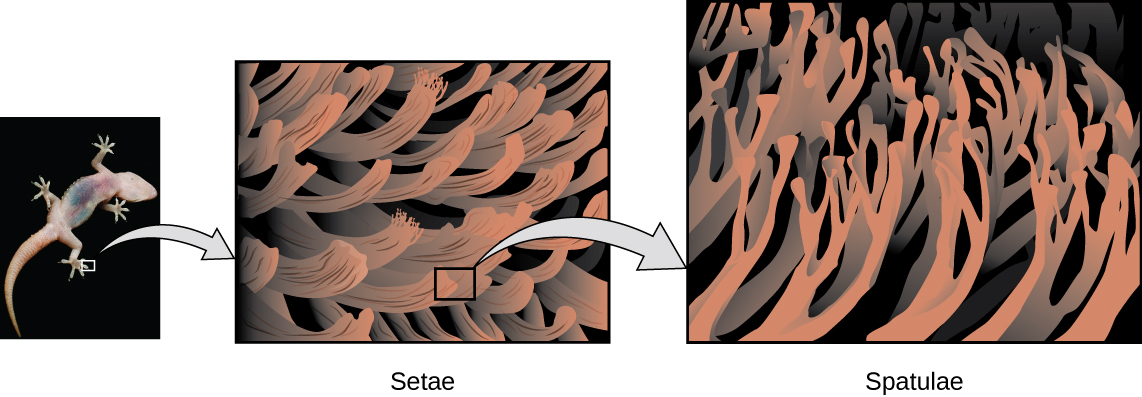
Geckos' toes are covered with hundreds of thousands of tiny hairs known as setae, with each seta, in turn, branching into hundreds of tiny, apartment, triangular tips called spatulae. The huge numbers of spatulae on its setae provide a gecko, shown in Effigy 7, with a large full surface area for sticking to a surface. In 2000, Kellar Autumn, who leads a multi-institutional gecko enquiry team, constitute that geckos adhered equally well to both polar silicon dioxide and nonpolar gallium arsenide. This proved that geckos stick to surfaces because of dispersion forces—weak intermolecular attractions arising from temporary, synchronized charge distributions betwixt adjacent molecules. Although dispersion forces are very weak, the total attraction over millions of spatulae is large enough to support many times the gecko'due south weight.
In 2014, two scientists developed a model to explicate how geckos can apace transition from "sticky" to "not-sticky." Alex Greaney and Congcong Hu at Oregon Land University described how geckos can achieve this by changing the angle betwixt their spatulae and the surface. Geckos' feet, which are commonly nonsticky, become glutinous when a minor shear force is applied. By crimper and uncurling their toes, geckos can alternate betwixt sticking and unsticking from a surface, and thus easily move across it. Further investigations may eventually lead to the development of better adhesives and other applications.
Watch this video to learn more virtually Kellar Autumn's research that determined that van der Waals forces are responsible for a gecko's ability to cling and climb.
Dipole-Dipole Attractions
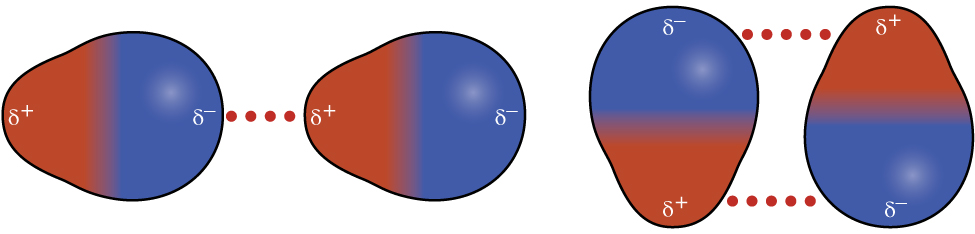
Recollect from the chapter on chemical bonding and molecular geometry that polar molecules have a partial positive accuse on 1 side and a partial negative accuse on the other side of the molecule—a separation of charge called a dipole. Consider a polar molecule such as hydrogen chloride, HCl. In the HCl molecule, the more than electronegative Cl atom bears the partial negative charge, whereas the less electronegative H atom bears the partial positive charge. An attractive forcefulness between HCl molecules results from the attraction between the positive end of one HCl molecule and the negative terminate of another. This attractive force is called a dipole-dipole attraction—the electrostatic force between the partially positive stop of ane polar molecule and the partially negative finish of another, as illustrated in Effigy 8.
The upshot of a dipole-dipole attraction is apparent when we compare the backdrop of HCl molecules to nonpolar F2 molecules. Both HCl and F2 consist of the same number of atoms and take approximately the same molecular mass. At a temperature of 150 K, molecules of both substances would have the same average KE. Nonetheless, the dipole-dipole attractions between HCl molecules are sufficient to cause them to "stick together" to form a liquid, whereas the relatively weaker dispersion forces between nonpolar F2 molecules are not, and so this substance is gaseous at this temperature. The higher normal boiling point of HCl (188 Thou) compared to F2 (85 K) is a reflection of the greater forcefulness of dipole-dipole attractions between HCl molecules, compared to the attractions between nonpolar Ftwo molecules. We will often apply values such as humid or freezing points, or enthalpies of vaporization or fusion, as indicators of the relative strengths of IMFs of attraction nowadays within different substances.
Case 2
Dipole-Dipole Forces and Their Effects
Predict which will have the higher humid point: Northtwo or CO. Explain your reasoning.
Solution
CO and Ntwo are both diatomic molecules with masses of almost 28 amu, and so they experience like London dispersion forces. Because CO is a polar molecule, it experiences dipole-dipole attractions. Because Northii is nonpolar, its molecules cannot showroom dipole-dipole attractions. The dipole-dipole attractions between CO molecules are comparably stronger than the dispersion forces between nonpolar North2 molecules, then CO is expected to have the college humid bespeak.
Check Your Learning
Predict which will take the college boiling betoken: ICl or Brtwo. Explain your reasoning.
Reply:
ICl. ICl and Brtwo take similar masses (~160 amu) and therefore experience similar London dispersion forces. ICl is polar and thus also exhibits dipole-dipole attractions; Br2 is nonpolar and does not. The relatively stronger dipole-dipole attractions crave more than free energy to overcome, so ICl will have the higher humid betoken.
Hydrogen Bonding
Nitrosyl fluoride (ONF, molecular mass 49 amu) is a gas at room temperature. Water (H2O, molecular mass 18 amu) is a liquid, even though it has a lower molecular mass. We clearly cannot attribute this divergence between the two compounds to dispersion forces. Both molecules take well-nigh the same shape and ONF is the heavier and larger molecule. It is, therefore, expected to experience more significant dispersion forces. Additionally, we cannot aspect this divergence in boiling points to differences in the dipole moments of the molecules. Both molecules are polar and exhibit comparable dipole moments. The large divergence between the humid points is due to a particularly strong dipole-dipole allure that may occur when a molecule contains a hydrogen cantlet bonded to a fluorine, oxygen, or nitrogen atom (the three most electronegative elements). The very large difference in electronegativity between the H atom (2.1) and the atom to which it is bonded (4.0 for an F cantlet, iii.5 for an O atom, or three.0 for a N cantlet), combined with the very minor size of a H cantlet and the relatively pocket-size sizes of F, O, or N atoms, leads to highly concentrated partial charges with these atoms. Molecules with F-H, O-H, or N-H moieties are very strongly attracted to like moieties in nearby molecules, a particularly strong type of dipole-dipole allure called hydrogen bonding. Examples of hydrogen bonds include HF⋯HF, H2O⋯HOH, and H3N⋯HNH2, in which the hydrogen bonds are denoted by dots. Effigy 9 illustrates hydrogen bonding between water molecules.
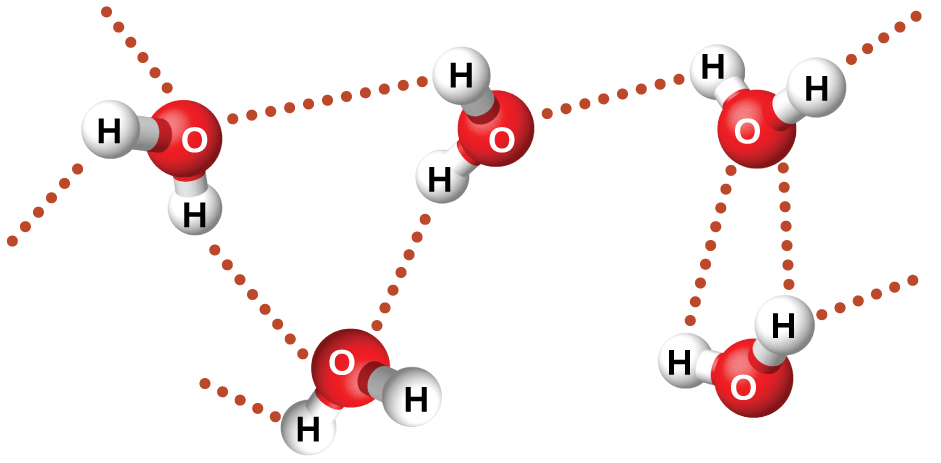
Despite utilise of the give-and-take "bond," continue in mind that hydrogen bonds are intermolecular bonny forces, non intramolecular attractive forces (covalent bonds). Hydrogen bonds are much weaker than covalent bonds, only nearly 5 to 10% as strong, but are by and large much stronger than other dipole-dipole attractions and dispersion forces.
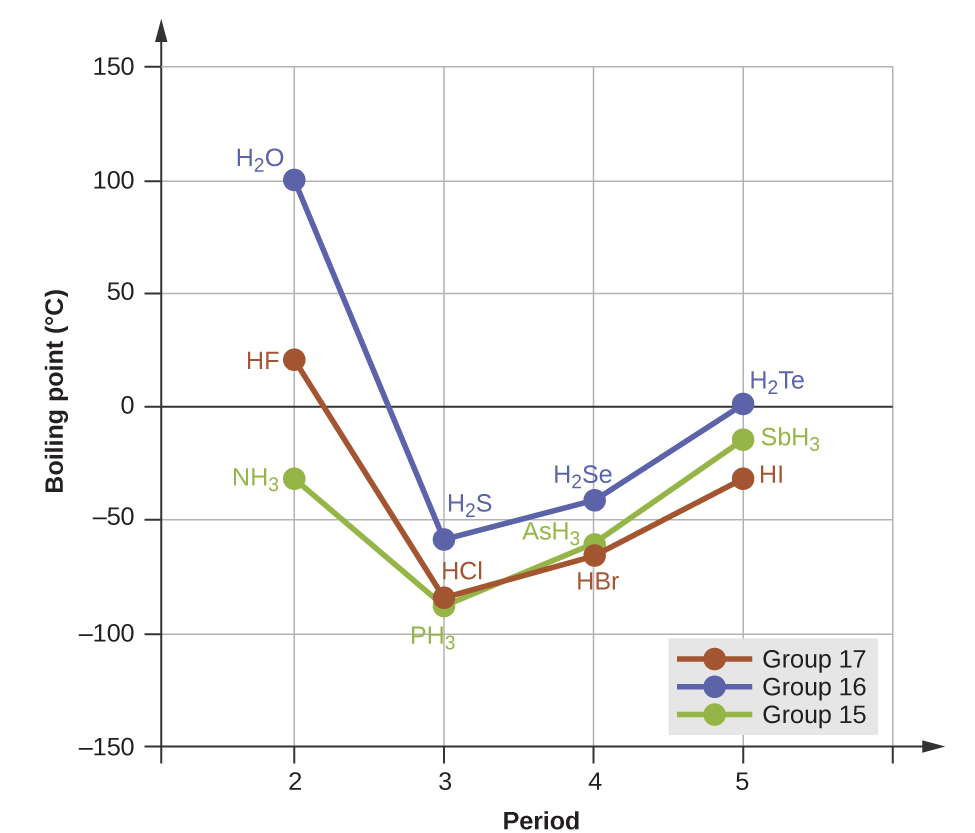
Hydrogen bonds have a pronounced effect on the properties of condensed phases (liquids and solids). For example, consider the trends in boiling points for the binary hydrides of grouping 15 (NH3, PH3, AsH3, and SbHiii), group 16 hydrides (HtwoO, HtwoS, HiiSe, and H2Te), and group 17 hydrides (HF, HCl, HBr, and Hullo). The humid points of the heaviest 3 hydrides for each group are plotted in Figure x. Equally we progress down any of these groups, the polarities of the molecules decrease slightly, whereas the sizes of the molecules increase substantially. The effect of increasingly stronger dispersion forces dominates that of increasingly weaker dipole-dipole attractions, and the boiling points are observed to increase steadily.
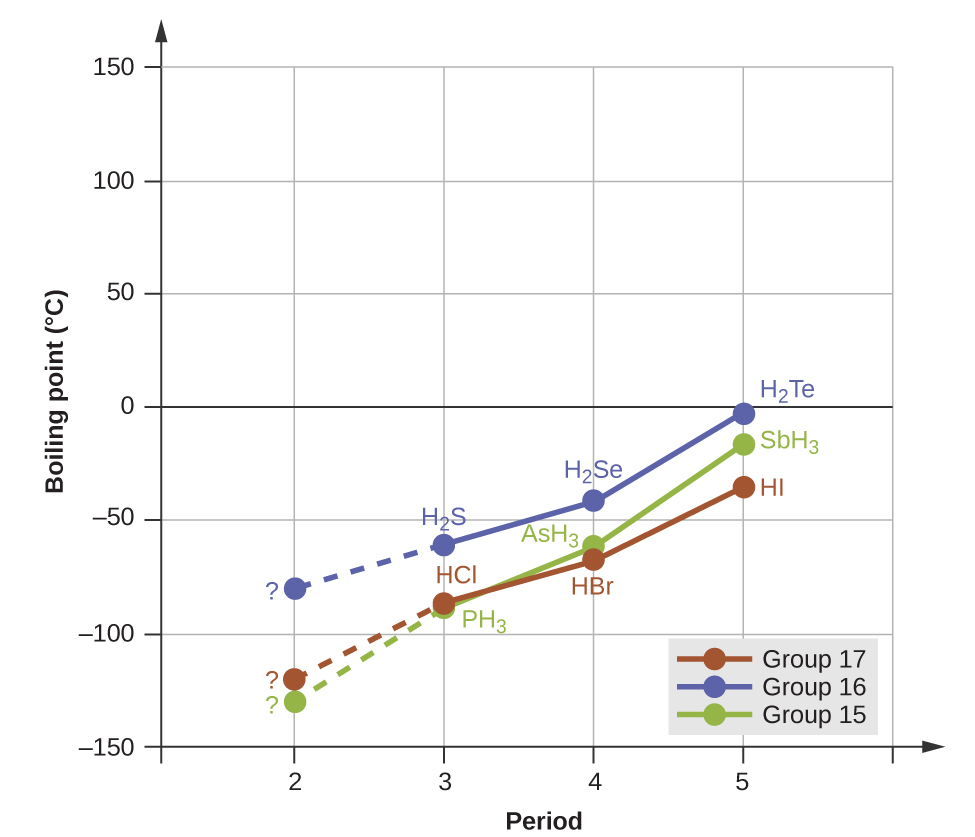
If nosotros use this trend to predict the boiling points for the lightest hydride for each group, we would expect NH3 to boil at about −120 °C, HiiO to eddy at about −80 °C, and HF to boil at about −110 °C. However, when we measure the humid points for these compounds, we notice that they are dramatically higher than the trends would predict, as shown in Figure 11. The stark contrast between our naïve predictions and reality provides compelling evidence for the force of hydrogen bonding.
Example iii
Outcome of Hydrogen Bonding on Boiling Points
Consider the compounds dimethylether (CHthreeOCH3), ethanol (CH3CH2OH), and propane (CH3CHiiCHthree). Their humid points, not necessarily in club, are −42.1 °C, −24.eight °C, and 78.iv °C. Friction match each chemical compound with its boiling point. Explain your reasoning.
Solution
The VSEPR-predicted shapes of CHthreeOCHiii, CH3CHiiOH, and CH3CHiiCH3 are like, as are their molar masses (46 g/mol, 46 g/mol, and 44 m/mol, respectively), so they will showroom like dispersion forces. Since CH3CH2CH3 is nonpolar, it may showroom but dispersion forces. Because CH3OCH3 is polar, it will too experience dipole-dipole attractions. Finally, CHiiiCHtwoOH has an −OH group, and and then it volition experience the uniquely strong dipole-dipole attraction known every bit hydrogen bonding. So the ordering in terms of force of IMFs, and thus humid points, is CHthreeCH2CH3 < CHthreeOCH3 < CHiiiCHtwoOH. The humid point of propane is −42.1 °C, the boiling point of dimethylether is −24.8 °C, and the boiling bespeak of ethanol is 78.5 °C.
Check Your Learning
Ethane (CHthreeCH3) has a melting point of −183 °C and a humid point of −89 °C. Predict the melting and boiling points for methylamine (CHiiiNH2). Explicate your reasoning.
Answer:
The melting betoken and boiling signal for methylamine are predicted to exist significantly greater than those of ethane. CHiiiCH3 and CH3NH2 are similar in size and mass, but methylamine possesses an −NH group and therefore may exhibit hydrogen bonding. This greatly increases its IMFs, and therefore its melting and boiling points. It is difficult to predict values, merely the known values are a melting betoken of −93 °C and a boiling point of −half-dozen °C.
Hydrogen Bonding and DNA
Deoxyribonucleic acid (Dna) is plant in every living organism and contains the genetic information that determines the organism'due south characteristics, provides the blueprint for making the proteins necessary for life, and serves every bit a template to pass this data on to the organism's offspring. A Dna molecule consists of two (anti-)parallel chains of repeating nucleotides, which course its well-known double helical structure, equally shown in Figure 12.
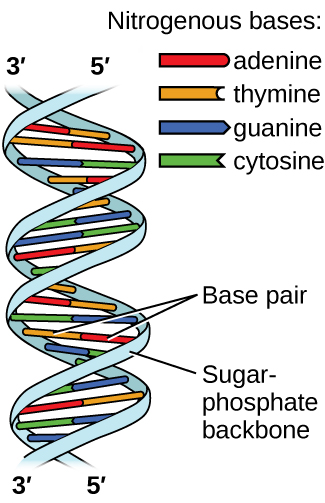
Each nucleotide contains a (deoxyribose) saccharide leap to a phosphate group on ane side, and i of four nitrogenous bases on the other. Two of the bases, cytosine (C) and thymine (T), are unmarried-ringed structures known every bit pyrimidines. The other two, adenine (A) and guanine (G), are double-ringed structures called purines. These bases class complementary base of operations pairs consisting of i purine and ane pyrimidine, with adenine pairing with thymine, and cytosine with guanine. Each base pair is held together by hydrogen bonding. A and T share ii hydrogen bonds, C and 1000 share three, and both pairings take a like shape and structure Figure 13.
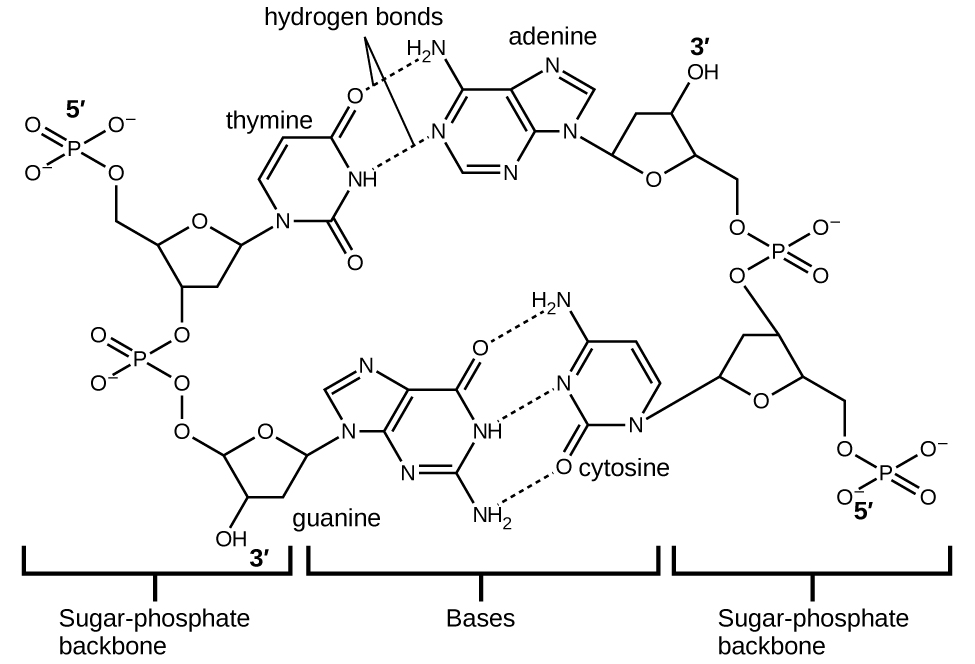
The cumulative effect of millions of hydrogen bonds finer holds the 2 strands of Dna together. Importantly, the two strands of Deoxyribonucleic acid can relatively easily "unzip" downwards the middle since hydrogen bonds are relatively weak compared to the covalent bonds that concur the atoms of the individual DNA molecules together. This allows both strands to part as a template for replication.
Key Concepts and Summary
The physical backdrop of condensed matter (liquids and solids) can exist explained in terms of the kinetic molecular theory. In a liquid, intermolecular attractive forces concur the molecules in contact, although they even so have sufficient KE to move past each other.
Intermolecular attractive forces, collectively referred to as van der Waals forces, are responsible for the behavior of liquids and solids and are electrostatic in nature. Dipole-dipole attractions result from the electrostatic attraction of the fractional negative end of 1 dipolar molecule for the partial positive terminate of another. The temporary dipole that results from the movement of the electrons in an atom can induce a dipole in an adjacent cantlet and requite ascent to the London dispersion force. London forces increment with increasing molecular size. Hydrogen bonds are a special type of dipole-dipole allure that results when hydrogen is bonded to one of the iii nearly electronegative elements: F, O, or N.
Chemistry End of Chapter Exercises
- In terms of their bulk backdrop, how do liquids and solids differ? How are they similar?
- In terms of the kinetic molecular theory, in what ways are liquids like to solids? In what means are liquids different from solids?
- In terms of the kinetic molecular theory, in what ways are liquids similar to gases? In what ways are liquids different from gases?
- Explain why liquids presume the shape of whatsoever container into which they are poured, whereas solids are rigid and retain their shape.
- What is the bear witness that all neutral atoms and molecules exert attractive forces on each other?
- Open the PhET States of Matter Simulation to reply the following questions:
(a) Select the Solid, Liquid, Gas tab. Explore by selecting unlike substances, heating and cooling the systems, and changing the state. What similarities do you find between the four substances for each phase (solid, liquid, gas)? What differences practise you find?
(b) For each substance, select each of the states and record the given temperatures. How do the given temperatures for each state correlate with the strengths of their intermolecular attractions? Explain.
(c) Select the Interaction Potential tab, and utilize the default neon atoms. Move the Ne cantlet on the right and notice how the potential energy changes. Select the Total Force push, and move the Ne atom as earlier. When is the total force on each atom attractive and big enough to matter? And then select the Component Forces push, and motion the Ne atom. When do the bonny (van der Waals) and repulsive (electron overlap) forces residue? How does this relate to the potential energy versus the distance betwixt atoms graph? Explain.
- Define the post-obit and requite an example of each:
(a) dispersion force
(b) dipole-dipole attraction
(c) hydrogen bail
- The types of intermolecular forces in a substance are identical whether it is a solid, a liquid, or a gas. Why so does a substance change phase from a gas to a liquid or to a solid?
- Why do the humid points of the noble gases increase in the order He < Ne < Ar < Kr < Xe?
- Neon and HF have approximately the same molecular masses.
(a) Explain why the humid points of Neon and HF differ.
(b) Compare the alter in the humid points of Ne, Ar, Kr, and Xe with the modify of the boiling points of HF, HCl, HBr, and Hullo, and explain the difference between the changes with increasing atomic or molecular mass.
- Arrange each of the following sets of compounds in gild of increasing boiling point temperature:
(a) HCl, H2O, SiHiv
(b) F2, Cl2, Br2
(c) CHfour, C2H6, C3H8
(d) O2, NO, North2
- The molecular mass of butanol, C4HixOH, is 74.14; that of ethylene glycol, CH2(OH)CH2OH, is 62.08, still their boiling points are 117.2 °C and 174 °C, respectively. Explain the reason for the difference.
- On the basis of intermolecular attractions, explain the differences in the boiling points of northward–butane (−1 °C) and chloroethane (12 °C), which have similar molar masses.
- On the footing of dipole moments and/or hydrogen bonding, explain in a qualitative manner the differences in the boiling points of acetone (56.2 °C) and ane-propanol (97.4 °C), which take like molar masses.
- The melting betoken of H2O(s) is 0 °C. Would you expect the melting point of HiiDue south(southward) to be −85 °C, 0 °C, or 185 °C? Explain your answer.
- Silane (SiHfour), phosphine (PH3), and hydrogen sulfide (H2S) melt at −185 °C, −133 °C, and −85 °C, respectively. What does this suggest nearly the polar character and intermolecular attractions of the iii compounds?
- Explicate why a hydrogen bond between ii h2o molecules is weaker than a hydrogen bond betwixt two hydrogen fluoride molecules.
- Under certain conditions, molecules of acerb acrid, CH3COOH, form "dimers," pairs of acerb acid molecules held together by potent intermolecular attractions:
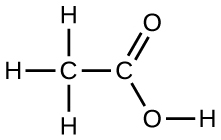
Describe a dimer of acetic acid, showing how two CH3COOH molecules are held together, and stating the blazon of International monetary fund that is responsible.
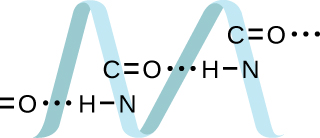
- Proteins are bondage of amino acids that can course in a variety of arrangements, one of which is a helix. What kind of IMF is responsible for holding the poly peptide strand in this shape? On the poly peptide image, show the locations of the IMFs that concord the protein together:
- The density of liquid NHiii is 0.64 g/mL; the density of gaseous NH3 at STP is 0.0007 g/mL. Explain the difference between the densities of these two phases.
- Identify the intermolecular forces present in the following solids:
(a) CH3CHtwoOH
(b) CH3CH2CH3
(c) CH3CHiiCl
Glossary
- dipole-dipole allure
- intermolecular attraction between 2 permanent dipoles
- dispersion force
- (besides, London dispersion forcefulness) attraction between 2 apace fluctuating, temporary dipoles; pregnant only when particles are very shut together
- hydrogen bonding
- occurs when exceptionally potent dipoles attract; bonding that exists when hydrogen is bonded to one of the three about electronegative elements: F, O, or N
- induced dipole
- temporary dipole formed when the electrons of an cantlet or molecule are distorted past the instantaneous dipole of a neighboring atom or molecule
- instantaneous dipole
- temporary dipole that occurs for a cursory moment in time when the electrons of an atom or molecule are distributed asymmetrically
- intermolecular force
- noncovalent attractive force between atoms, molecules, and/or ions
- polarizability
- mensurate of the ability of a charge to distort a molecule'south charge distribution (electron cloud)
- van der Waals force
- attractive or repulsive force between molecules, including dipole-dipole, dipole-induced dipole, and London dispersion forces; does not include forces due to covalent or ionic bonding, or the attraction between ions and molecules
Solutions
Answers to Chemistry End of Chapter Exercises
1. Liquids and solids are like in that they are matter composed of atoms, ions, or molecules. They are incompressible and have similar densities that are both much larger than those of gases. They are different in that liquids have no fixed shape, and solids are rigid.
3. They are similar in that the atoms or molecules are complimentary to move from one position to some other. They differ in that the particles of a liquid are confined to the shape of the vessel in which they are placed. In contrast, a gas volition aggrandize without limit to fill up the infinite into which it is placed.
5. All atoms and molecules will condense into a liquid or solid in which the attractive forces exceed the kinetic energy of the molecules, at sufficiently low temperature.
7. (a) Dispersion forces occur every bit an cantlet develops a temporary dipole moment when its electrons are distributed asymmetrically about the nucleus. This structure is more prevalent in big atoms such every bit argon or radon. A 2d cantlet can then be distorted by the appearance of the dipole in the get-go atom. The electrons of the 2nd atom are attracted toward the positive stop of the first cantlet, which sets upwardly a dipole in the 2nd atom. The internet consequence is apace fluctuating, temporary dipoles that attract one another (example: Ar). (b) A dipole-dipole attraction is a force that results from an electrostatic allure of the positive end of one polar molecule for the negative terminate of some other polar molecule (example: ICI molecules attract one another by dipole-dipole interaction). (c) Hydrogen bonds grade whenever a hydrogen cantlet is bonded to one of the more electronegative atoms, such as a fluorine, oxygen, or nitrogen atom. The electrostatic attraction between the partially positive hydrogen atom in one molecule and the partially negative atom in another molecule gives ascension to a strong dipole-dipole interaction called a hydrogen bond (example: [latex]\text{HF}{\cdots}\text{HF}[/latex]).
9. The London forces typically increase every bit the number of electrons increase.
11. (a) SiH4 < HCl < HtwoO; (b) Ftwo < Clii < Br2; (c) CH4 < C2H6 < C3H8; (d) N2 < O2 < NO
13. Only rather small dipole-dipole interactions from C-H bonds are available to hold n-butane in the liquid land. Chloroethane, however, has rather large dipole interactions because of the Cl-C bond; the interaction is therefore stronger, leading to a higher boiling point.
15. −85 °C. H2o has stronger hydrogen bonds so it melts at a college temperature.
17. The hydrogen bail between two hydrogen fluoride molecules is stronger than that between two h2o molecules because the electronegativity of F is greater than that of O. Consequently, the fractional negative charge on F is greater than that on O. The hydrogen bond betwixt the partially positive H and the larger partially negative F will exist stronger than that formed betwixt H and O.
19. H-bonding is the principle IMF holding the Dna strands together. The H-bonding is betwixt the [latex]\text{N}-\text{H}[/latex] and [latex]\text{C}=\text{O}[/latex].
21. (a) hydrogen bonding and dispersion forces; (b) dispersion forces; (c) dipole-dipole allure and dispersion forces
Source: https://opentextbc.ca/chemistry/chapter/10-1-intermolecular-forces/
0 Response to "what are the strongest types of intermolecular forces that must be overcome in order to:"
Post a Comment